
Should I Update My Bathroom or Save for a Full Remodel?
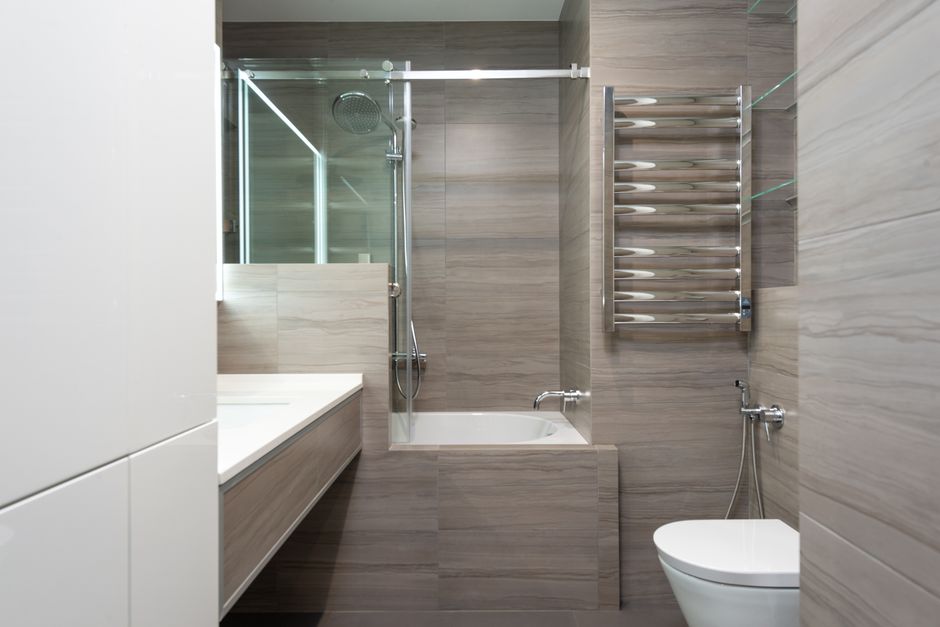
Update first when the bathroom's layout works, its condition is sound, and the main problem is visual wear or dated fixtures. Preserve the footprint, replace the elements you touch and see most, and reserve a full remodel for shower work, deteriorated systems, or layout failures. This approach controls scope while avoiding cosmetic work that must soon be removed.
Should I update my bathroom or save for a full remodel?
Update when the room has a functioning layout and the needed work can remain on the surface; save for a full remodel when the shower, plumbing, ventilation, or condition problem reaches behind those surfaces. The useful distinction is not whether the bathroom looks old. It is whether the fix requires undoing work you have just paid to finish.
The evidence favors treating footprint changes as an exception, not a default. In the Houzz 2025 U.S. Bathroom Trends Study, 82% of renovated bathrooms stayed about the same size. That figure does not prove that every room should remain unchanged; it establishes the more modest proposition that many bathroom problems are solved without moving walls or plumbing.
Cost data reveals why scope discipline matters. The 2023 American Housing Survey reports a median bathroom-remodel expenditure of $5,000, while plumbing fixtures had a median expenditure of $800. Houzz reports a higher 2024 median of $7,500 for a minor remodel without a shower upgrade and $22,000 for a major remodel with at least a shower upgrade. These are different surveys with different definitions, not competing price quotes. Read them as a boundary: a shower upgrade is a meaningful dividing line between a contained update and a larger commitment.
| Condition to assess | Refresh-first decision | Save for a full remodel when |
|---|---|---|
| Layout | Keep it when circulation and storage work. | Change it only when the layout itself prevents the bathroom from functioning. |
| Shower | Leave it outside the scope when it is not the source of the problem. | Plan a larger project when a shower upgrade is required. |
| Plumbing | Use a fixture-focused scope after confirming local requirements. | Pause cosmetic work when plumbing changes or repairs must come first. |
| Resale | Correct visible condition and style problems selectively. | Do not assume a full renovation will return all of its cost. |
The blunt diagnosis is simple: a full remodel is justified by a system or layout problem, not by the mere existence of dated finishes.
What bathroom upgrades make the biggest visual difference?
The biggest visual difference usually comes from coordinated changes to the vanity area, fixtures, lighting, mirror, paint, and ventilation rather than from a single expensive object. These elements occupy the visual center of the room or affect its daily use; changing them together can make an unchanged footprint read as intentional rather than unfinished.
Start with the vanity zone: cabinet, countertop if included in the selected product, faucet, mirror, and lighting. This is not an argument for maximum spending. It is an argument for avoiding an incoherent mix, where one new fixture calls attention to every adjacent worn surface. A smaller, complete visual composition generally has more impact than scattered replacements.
Then address the room's operating conditions. An exhaust-fan replacement is less theatrical than a mirror, but it is a rational part of a modest update because it handles an existing bathroom function without requiring a new layout. The U.S. Environmental Protection Agency's ENERGY STAR ventilation-fan criteria set maximum sound levels of 2.0 sones for certified bathroom and utility-room fans rated from 10 to 200 CFM. For models rated from 10 to 89 CFM, the minimum efficacy is 2.8 CFM per watt; for 90 to 200 CFM models, it is 3.5 CFM per watt. Those specifications provide a concrete comparison point when quiet operation and efficiency are priorities.
Finish with paint and careful repair of what remains. The National Association of REALTORS' 2025 Remodeling Impact Report found that 50% of REALTORS recommended painting the entire home before selling and 41% recommended painting one interior room, compared with 24% who recommended a bathroom renovation. The implication is not that paint replaces every bathroom project. It is that visible finish condition deserves attention before a costly renovation is assumed necessary.
How much does it cost to update a bathroom without moving plumbing?
A no-layout-change update has no single reliable price because the available national figures use different scopes, but the published medians provide useful guardrails: $800 for plumbing fixtures, $5,000 for a bathroom remodel in the American Housing Survey, and $7,500 for Houzz's minor remodel category without a shower upgrade. Set the budget by scope and stop conditions, not by selecting a number and hoping the work fits inside it.
Use the figures as planning bands rather than promises. The U.S. Census Bureau and U.S. Department of Housing and Urban Development report that owners spent a median of $6,500 on all home improvements from 2021 through 2023, and that bathroom remodels accounted for 12.8 million projects and $82.4 billion in expenditures. Bathroom work is common; it is not therefore standardized.
| Budget approach | Scope logic | What keeps it modest |
|---|---|---|
| Fixture-led | Target faucets and other plumbing fixtures. | Median plumbing-fixture expenditure was $800 in the American Housing Survey. |
| Minor refresh | Coordinate finishes while avoiding a shower upgrade. | Houzz reported a $7,500 median for a minor remodel in 2024. |
| Small-bath benchmark | Use published size-specific context when applicable. | Houzz reported a $5,000 median for bathrooms under 100 square feet in its minor-remodel category. |
| Major-project threshold | Reassess the plan before adding a shower upgrade. | Houzz reported a $22,000 median for major remodels, defined as including at least a shower upgrade. |
Professional help is not a failure of a modest plan. The American Housing Survey found professionals completed 64% of reported improvement projects, and Houzz found 84% of renovating homeowners hired a professional. Harvard University's Joint Center for Housing Studies likewise reported that professionally installed project spending rose 14% in real terms from 2021 to 2023 while DIY spending fell 13%. The appropriate dividing line is technical risk: hire qualified trades for work that requires them, then keep the design scope narrow.
Permits are local, which means no national article can tell you whether a particular fixture change needs one. The Minnesota Department of Labor and Industry instructs homeowners and contractors to check with the local administrative authority for plan-review requirements and verify that a project qualifies for a minor-remodel permit. Treat that as the correct sequence everywhere: confirm requirements before ordering fixtures or closing walls.
Sequence the work in the order that prevents rework: define scope, verify local requirements, resolve plumbing and ventilation, complete any required inspections, then install permanent finishes and accessories. A cosmetic update succeeds when the last item installed is genuinely last.
Frequently Asked Questions
Can I replace a vanity without replacing the floor?
Yes, if the existing floor is sound and the new vanity works with its visible condition and dimensions. The practical constraint is sequencing: address any concealed plumbing issue before installing the vanity, because later repairs can require removing the new cabinet. A vanity replacement can be a contained update when it does not trigger floor or plumbing changes.
Which bathroom updates are worth doing before selling a house?
A bathroom refresh is worth considering when its condition or appearance could become an obvious buyer objection, but it should not be treated as an automatic profit project. The National Association of REALTORS' 2025 report estimates a bathroom renovation recovers 50% of project cost at resale, while 24% of REALTORS recommended one before selling. Its data also shows that painting was recommended more often, so start with visible condition and finish issues before expanding the scope.
What should I not change in a budget bathroom update?
Do not change a functioning layout merely to make the project feel more substantial. Moving plumbing broadens the work, introduces local permit and inspection questions, and can turn a refresh into a remodel. Avoid installing finished items before ventilation, plumbing, and any required inspections are resolved.
Sources
- U.S. Census Bureau and U.S. Department of Housing and Urban Development, 2023 American Housing Survey
- National Association of REALTORS, 2025 Remodeling Impact Report
- Joint Center for Housing Studies of Harvard University, Improving America's Housing 2025
- Houzz, 2025 U.S. Bathroom Trends Study
- U.S. Environmental Protection Agency, ENERGY STAR Ventilation Fans Key Product Criteria
- Minnesota Department of Labor and Industry, Minor Remodel Plumbing Projects