
How Can I Refresh My Living Room Without Replacing Everything?
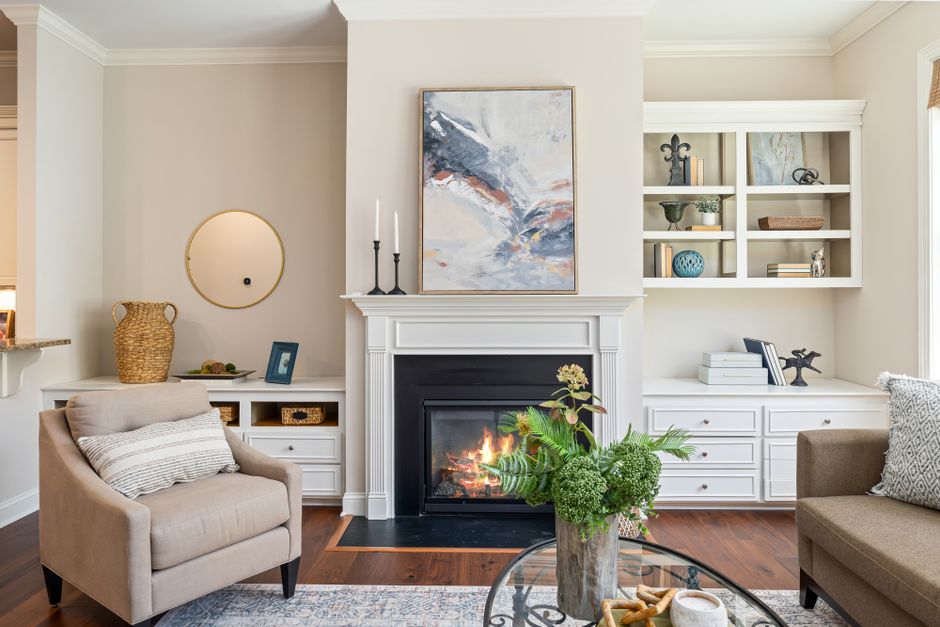
Refresh a living room by keeping the functional large pieces, then changing the layers that control warmth and personality: wall color, lighting, textiles, art, plants, and one contrasting accent. This approach avoids costly social-media micro-trends, gives a beige or gray room more depth, and lets you test a new direction before committing to replacement furniture.
That order matters. Harvard's Joint Center for Housing Studies reports that average homeowner spending on improvements was almost $4,700 in 2023, while professionally installed project spending rose 14% in real terms from 2021 to 2023. A room does not need to become a contractor-led project simply because it feels stale. Start with the changes that are reversible, visible, and easy to live with.
What living room trends are going out of style in 2026?
The 2026 retreat list is clear: oversized cloud sectionals, wavy decor used everywhere, ultra-minimal beige-and-white rooms, and full matching furniture sets are losing ground. The Spruce reports designer views that these large cloud sectionals can make a smaller room feel visually heavy, while wavy shapes work better as a single accent than as a whole-room commitment.
The practical rule is the anchor-and-accent split. Buy or keep classic, proportionate shapes for expensive anchors such as the sofa, coffee table, and main storage. Put the current-looking move in a lower-cost accent: a sculptural lamp, a side chair, a pillow cover, or a small object. The accent can leave when the look wears out. The anchor does not have to.
Do not confuse “less trendy” with “less personal.” Houzz reported that U.S. searches for warm color schemes rose nearly 2.5 times year over year in its January-to-March 2025 comparison, and searches for vintage living rooms doubled. That points toward rooms assembled over time, not rooms ordered as one matching package. The trend worth borrowing is restraint: choose a direction, then leave enough visual quiet for it to register.
How can I make a beige or gray living room feel warmer?
Make a beige or gray living room warmer by adding temperature contrast: wood, warm-colored textiles, warmer metal finishes, daylight, and living greenery. The goal is not to erase every neutral. The goal is to stop every surface from landing at the same pale, cool midpoint.
Run this four-part drill before shopping:
| Layer | Low-cost move | What it fixes |
|---|---|---|
| Light | Add or reposition a warm-toned table or floor lamp. | Flattens a cold evening mood without changing furniture. |
| Texture | Use a woven throw, textured cushions, or a rug with visible variation. | Breaks up smooth, uniform neutral surfaces. |
| Natural material | Bring in wood, a woven basket, or a ceramic piece. | Adds material contrast to gray upholstery and painted walls. |
| Life | Place a plant where it receives suitable daylight. | Creates a focal point that is not another decorative object. |
This is not decoration for decoration's sake. The American Society of Landscape Architects identifies daylight, natural materials, and vegetation as fundamental biophilic-design applications. Its cited review also discusses benefits associated with living walls, including restorativeness and well-being. A single plant will not turn a room into a living wall, but it is a useful, low-commitment way to introduce that natural-material logic.
Use a simple before-and-after test. Weak version: “Everything is beige, so add more beige texture.” Strong version: “Keep the beige sofa, then add one wood tone, one warm textile color, and one living element.” Three deliberate contrasts reduce the room's cognitive load better than ten decorative purchases.
Lighting can carry more weight than its price suggests. Houzz Research found that searches for gold lamps rose 42% in the same 2024-to-2025 comparison. A gold finish is optional; the useful lesson is smaller-scale lighting can shift a neutral room's warmth without forcing a furniture replacement.
Are matching living room furniture sets outdated?
Matching living room furniture sets are not forbidden, but a complete sofa, loveseat, and chair set can now read generic and overly staged. Apartment Therapy quotes designer Sydney Levy's critique of the full matching set and describes a preference for mixed silhouettes and fabrics in more curated rooms.
Use the two-repeat rule instead. Repeat two elements so the room feels connected, then vary the rest. For example, repeat the sofa's wood tone in a side table and frame; repeat the accent chair's color in two cushions; let the chair's silhouette differ from the sofa. You get coherence without the showroom effect.
Keep a matching set when it is comfortable, correctly scaled, and in good repair. Break it up before replacing it: move one chair to another room, recover its cushions if that is practical, or place a different side table and lamp beside it. This is the same budget logic behind deciding whether to update or rebuild in Should I Update My Bathroom or Save for a Full Remodel?: protect the parts that work, and direct money toward the change that solves the actual problem.
There is also a disposal cost to treating every style shift as a replacement cycle. The U.S. Environmental Protection Agency reports that furniture and furnishings generated 12.1 million tons of municipal solid waste in 2018, with 80.1% of discarded furniture and furnishings landfilled. A worn-out, unsafe, or badly scaled item may need to go. A merely unfashionable but usable item deserves a repair, reupholstery, rearrangement, or a new supporting cast first.
Use the low-cost refresh order
Work from reversible to permanent. First, remove the accessories that duplicate one another or belong to an old color scheme. Second, rearrange the room around conversation, reading, or the view rather than around habit. Third, introduce light and textiles. Fourth, add art, a natural material, and greenery. Only then assess whether a major piece is still the bottleneck.
Write one sentence before buying anything: “This room should feel warm, collected, and easy to use.” If a purchase does not support that sentence, it is not a refresh. It is clutter with a receipt. Your homework this week: identify one item to keep, one layer to change, and one object to remove. Make those three moves before opening a furniture tab.
Frequently Asked Questions
How do I add personality without making my living room look trendy?
Use items with a clear connection to your taste or daily life, then repeat one or two colors so they read as a group. Keep permanent, expensive pieces in classic shapes and put the experimental choice in an accent chair, pillow cover, lamp, or small decorative object.
What can I change first when I cannot afford new furniture?
Start with the light, textiles, and layout. Move existing furniture to improve the conversation area, add a warm-toned lamp, introduce a rug or throws with texture, and edit accessories that do not support the room's color plan.
Are oversized cloud sofas still in style?
Designer commentary collected by The Spruce and Apartment Therapy identifies oversized cloud sectionals as a look receding in 2026, particularly where their scale overwhelms the room. If yours is comfortable and fits the room, keep it; make it look more intentional with tailored cushions, a structured side table, and less bulky surrounding decor.